Mountain Gorillas: Facts, Weight, Lifespan, Size, and Tours.
All You Need To Know About Mountain Gorillas
Mountain gorillas are among East Africa’s most remarkable wildlife treasures, found in two isolated populations within the Greater Virunga and Bwindi-Sarambwe landscapes of Uganda, Rwanda, and the Democratic Republic of Congo. In Uganda, they inhabit the misty forests of Bwindi Impenetrable National Park and the Virunga slopes of Mgahinga Gorilla National Park. These high-altitude forests provide essential habitat for this endangered subspecies, making Uganda one of the world’s leading destinations for responsible mountain gorilla tourism.
Gorilla tourism plays an important role in conservation, research, and support for communities surrounding protected areas. Visitors can take part in regulated gorilla trekking in Uganda and Rwanda, while Uganda’s Gorilla Habituation Experience offers an extended opportunity to observe gorillas undergoing habituation in Bwindi. Conservation efforts across national borders are coordinated through regional partnerships, helping protect gorillas and their shared forest ecosystem. For travellers seeking a meaningful East African wildlife adventure, mountain gorilla encounters offer a rare opportunity to appreciate these extraordinary primates while contributing to the broader conservation story.
Mountain gorillas: facts, weight, lifespan, size, habitat, and tours, with essential insights for planning an unforgettable Ugandan gorilla safari adventure.
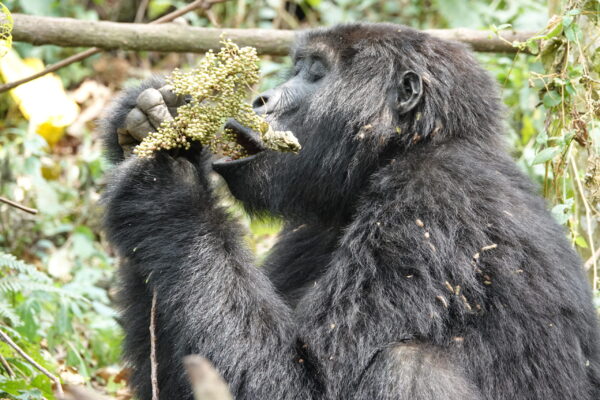
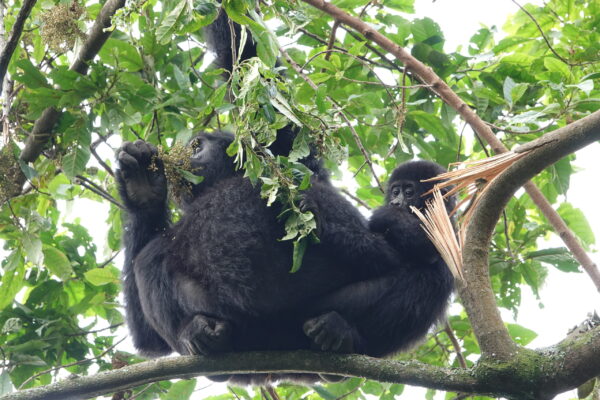
1. Mountain Gorilla Facts
Mountain gorillas (Gorilla beringei beringei) are an endangered subspecies of eastern gorilla found only in the forests of Uganda, Rwanda, and the Democratic Republic of Congo. They live in organised family groups generally led by one or more dominant silverback males, alongside females and younger gorillas. Mountain gorillas are primarily herbivorous, feeding on leaves, shoots, stems, bark, roots, and other vegetation. They have distinctive thick, dark fur that helps them cope with cool conditions at high elevations. Their conservation is considered a major success story, with populations increasing through habitat protection, monitoring, veterinary intervention, and responsible tourism.
2. Mountain Gorilla Weight
Mountain gorillas are powerful, heavily built primates, with adult males considerably larger and heavier than females. WWF reports that males can weigh up to approximately 180 kilograms (440 pounds), while females are considerably smaller. Their muscular bodies, broad chests, long arms, and strong hands are adaptations suited to moving through dense mountain forests. Silverbacks, the mature males that develop characteristic silver hair across their backs, use their strength to protect and lead their family groups. Despite their impressive size, mountain gorillas are predominantly peaceful herbivores when left undisturbed. Their physical strength and social organisation make them one of Africa’s most fascinating great apes.
3. Mountain Gorilla Lifespan
Mountain gorillas can live for several decades, although lifespan varies according to health, environmental conditions, disease, injuries, and other factors. Their slow reproductive rate means that population recovery takes considerable time when individuals are lost. Females generally give birth to a single infant after a long interval, often around four to six years between births. This makes every individual important to the survival of the species. Conservation programmes therefore focus heavily on protecting gorilla families, monitoring their health and reducing threats such as disease, habitat disturbance and human-wildlife conflict. Long-term research and veterinary support have contributed significantly to mountain gorilla conservation.
4. Mountain Gorilla Size
Mountain gorillas are among the largest living primates. Adult males can reach around 4 to 5.5 feet (1.2–1.7 metres) in standing height, although they normally move on all fours rather than walking upright. Their compact, muscular bodies are complemented by broad chests, long arms and large hands. Mature males develop a distinctive silver-grey saddle of hair across their back, which gives them the name “silverback”. Females are smaller than males but possess the same characteristic dark coat and powerful build. Their size, strength, and thick fur are well suited to life in the cool, dense forests of the Albertine Rift.
5. Mountain Gorilla Habitat
Mountain gorillas occupy a remarkably restricted habitat in East-Central Africa. They live in two isolated populations: one in the Virunga Massif, where Uganda, Rwanda, and the Democratic Republic of Congo meet, and another in Uganda’s Bwindi Impenetrable National Park, extending toward the Sarambwe area in the Democratic Republic of Congo. Their habitat consists primarily of high-altitude montane and bamboo forests, with UWA describing elevations of approximately 8,000–13,000 feet (1,400–3,800 metres). The forests provide abundant vegetation, shelter, and suitable conditions for their family groups. Protecting these forests is therefore fundamental to the long-term survival of mountain gorillas and the wider ecosystem.

Mountain Gorilla Safari Tours To Inspire You
Uganda Gorilla Trekking Safari
Explore Bwindi Impenetrable National Park, home to roughly half of the world’s mountain gorillas. This safari combines guided forest trekking with opportunities to encounter habituated gorilla families, making it ideal for travellers seeking an authentic wildlife adventure.
Uganda Gorilla Habituation Safari
Spend up to four hours observing a semi-habituated gorilla family in Bwindi. This specialist safari provides additional time to appreciate gorilla behaviour and conservation work, making it especially appealing to photographers, researchers and passionate primate enthusiasts.
Uganda Gorilla & Chimpanzee Safari
Combine mountain gorilla trekking in Bwindi with chimpanzee tracking in Kibale National Park. The itinerary brings together two of Uganda’s most remarkable primate encounters while showcasing contrasting rainforest ecosystems and wildlife landscapes across the country.
Uganda Gorilla & Big Five Safari
Pair gorilla trekking in Bwindi with classic savanna wildlife viewing in Queen Elizabeth National Park or another Ugandan wildlife destination. It is an excellent choice for travellers wanting to combine a rare primate encounter with lions, elephants, buffaloes and other iconic safari wildlife.
Rwanda Mountain Gorilla Safari
Trek mountain gorillas in Rwanda’s Volcanoes National Park, part of the Virunga landscape. This option suits travellers seeking a focused gorilla safari with relatively convenient access from Kigali, while also offering opportunities to explore Rwanda’s volcanic scenery and conservation heritage.
Uganda & Rwanda Combined Gorilla Safari
Visit both Uganda and Rwanda for a broader mountain-gorilla journey across Bwindi and Volcanoes National Park. This cross-border itinerary combines two distinctive forest settings and can be extended with chimpanzee tracking, wildlife safaris and other East African attractions.